LOCAL-FIRST · PRIVATE · RECEIPT-BACKED

Nexus of Vay

Local-first intelligence. Human-controlled systems.

A private AI infrastructure project built around a model-agnostic agentic harness, persistent memory, governed execution, adaptive context management, and long-running autonomous workflows. Designed to scale across models, context sizes, tools, hardware, and specialized agents without binding the system to any single reasoning engine.

in development private infrastructure owner-controlled
The Vay orb
Public values, private processing.
01 · LIVE

Watch Vay work

A read-only window onto the running system: what the agent is doing, step by step, as it happens. This page accepts no input — you can watch, and nothing more. The controls stay on hardware the owner holds.

CONNECTING…
no user input accepted
waiting for the stream…
    events are redacted at the source · paths and file contents are never published
    02 · ABOUT

    What is Vay?

    Vay is a private, local-first AI system built around a simple idea: the intelligence should not be trapped inside a model, a context window, or a single conversation.

    Vay is not a model. It is the persistent infrastructure surrounding the model — an agentic runtime designed to give interchangeable AI models memory, tools, continuity, execution, supervision, recovery, and an environment in which they can perform real work.
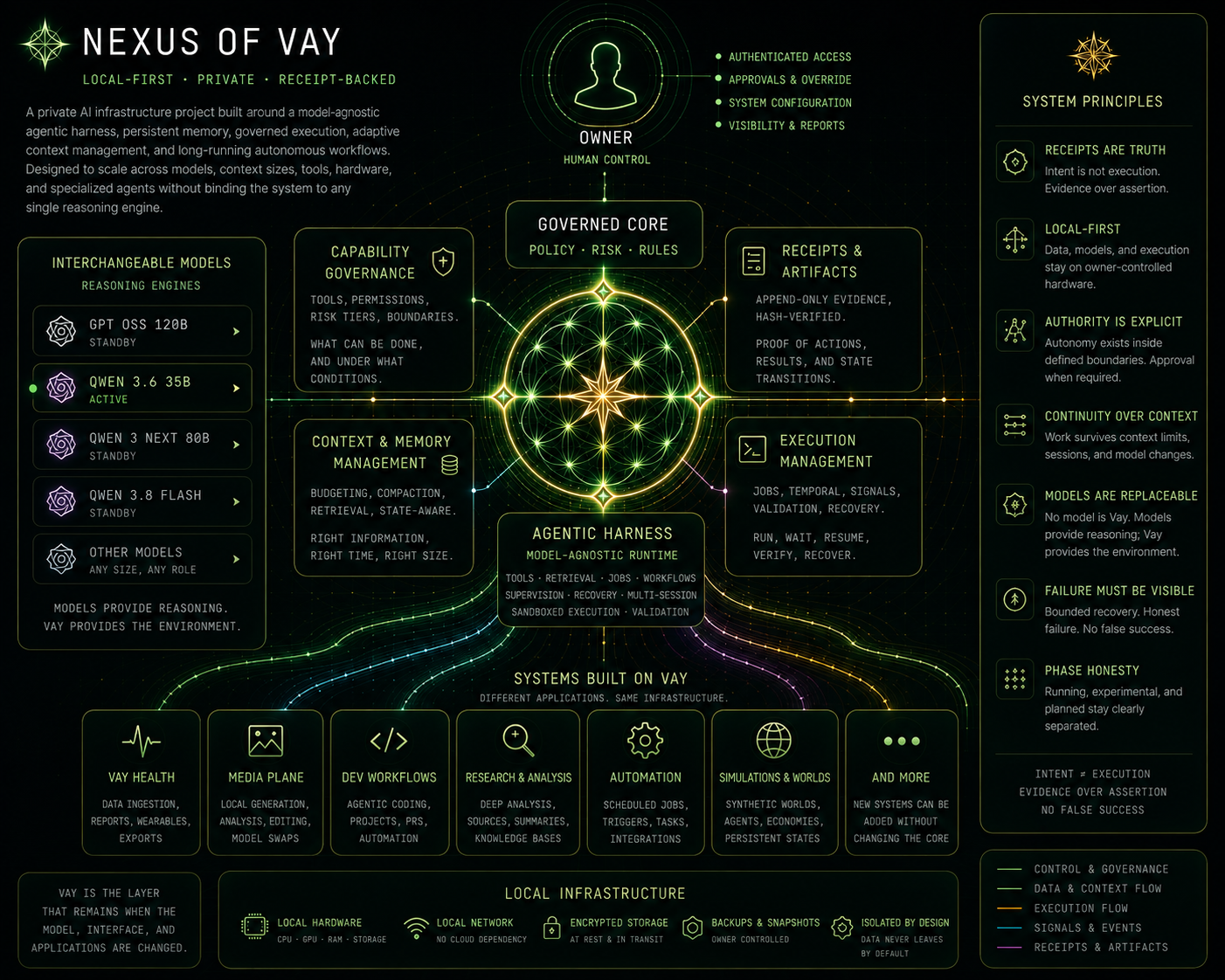
    Nexus of Vay system architecture: the owner above a governed core, an agentic harness routing to tools and capabilities, interchangeable models on the left, systems built on Vay below, and local infrastructure beneath.
    system architecture · illustrative — see “Running today” for current capability status
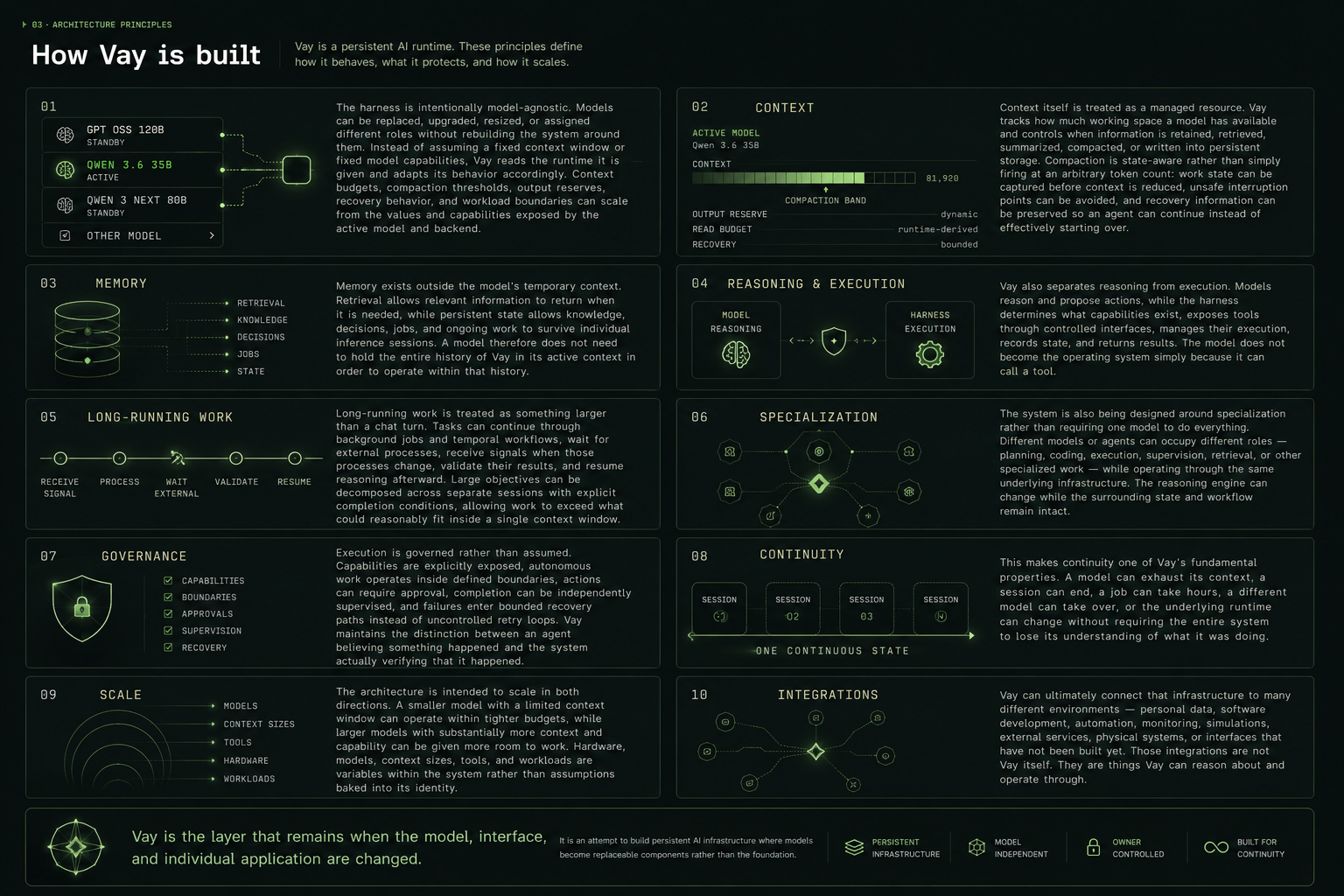
    How Vay is built — ten architecture principles: model-agnostic, context, memory, reasoning and execution, long-running work, specialization, governance, continuity, scale, and integrations. Vay is the layer that remains when the model, interface, and individual application are changed.
    how Vay is built · tap or click to open full size
    03 · PRINCIPLES

    System principles

    Vay is built around a fixed set of architectural principles. Models, hardware, interfaces, and capabilities can change; these rules define how the system behaves regardless of what reasoning engine is operating inside it.

    Receipts are truth
    Intent is not execution. Vay distinguishes between what a model proposed, what the system attempted, and what actually occurred. Consequential actions produce durable evidence so success, failure, denial, and incomplete work can be represented honestly rather than inferred from model output.
    Local-first
    Models, memory, state, retrieval, and core execution live on owner-controlled hardware. External services may be deliberately connected when useful, but they are integrations rather than dependencies. The core remains functional without surrendering its state or authority to a remote platform.
    Authority is explicit
    Autonomy exists inside defined boundaries. Capabilities, tools, risk levels, and approval requirements determine what an agent may execute. Some actions can proceed autonomously; others require explicit owner approval. Authority is granted by the system — never assumed by the model.
    Continuity over context
    A context window is temporary; Vay's state is not. Memory, retrieval, compaction, checkpoints, jobs, and persistent task state allow work to survive context limits, inference cycles, session boundaries, model changes, and long-running execution.
    Models are replaceable
    No individual model is Vay. The harness is designed to adapt to different models, context capacities, hardware configurations, and capabilities. Models provide reasoning; Vay provides the persistent environment in which that reasoning operates.
    Failure must be visible
    Failure is a valid system state, not something to hide behind retries or confident language. Recovery is bounded, completion can be independently validated, and exhausted recovery paths stop honestly rather than manufacturing success.
    Phase honesty
    Running, experimental, and planned capabilities remain explicitly separated. Vay does not present an intended capability as an implemented one. The system — and the site describing it — should represent what exists now without borrowing credibility from what may exist later.
    RECEIPT LOG · illustrative
    09:40 · self_check.okverified
    09:38 · report.save · #r_91c4verified
    09:31 · task.proposeawaiting approval
    intent ≠ execution · evidence over assertion · no false success
    04 · DELIVERED

    Running today

    Phase honesty is a rule, not a style: this section lists only systems operating today on local hardware and verified through real execution. Experimental and planned capabilities remain on the roadmap.

    {{ mod.name }}
    {{ mod.tag }}
    {{ mod.body }}
    05 · ROADMAP

    Built in phases, honestly labeled

    NOW
    Hardening the harness
    Vay's agentic runtime is operational: persistent work, retrieval, adaptive context management, compaction, supervision, temporal execution, bounded recovery, background jobs, and controlled tool access. Current work is focused on hardening these systems, testing failure modes, and making behavior consistent across models and context sizes.
    NEAR-TERM
    Model-independent scale
    Expand the harness's ability to adapt automatically to the model and runtime beneath it. Context limits, read/write behavior, compaction, workload sizing, recovery, and execution strategy become runtime-aware — allowing models of different sizes and capabilities to operate through the same persistent architecture.
    LATER
    Multi-agent continuity
    Extend Vay beyond individual agent sessions into coordinated, specialized reasoning. Planning, coding, research, supervision, and other roles can operate independently while sharing persistent state, handing work between sessions, and continuing objectives beyond any single model's context window.
    EXPERIMENTAL
    Beyond the harness
    Explore voice, persistent synthetic environments, physical-system interfaces, specialized local models, distributed execution, and new forms of long-term AI memory and interaction — without making experimental systems dependencies of the stable core.

    Questions about the project?

    Nexus of Vay is a private, local-first project in active development.
    For questions or correspondence:

    Kasey@nexusofvay.com